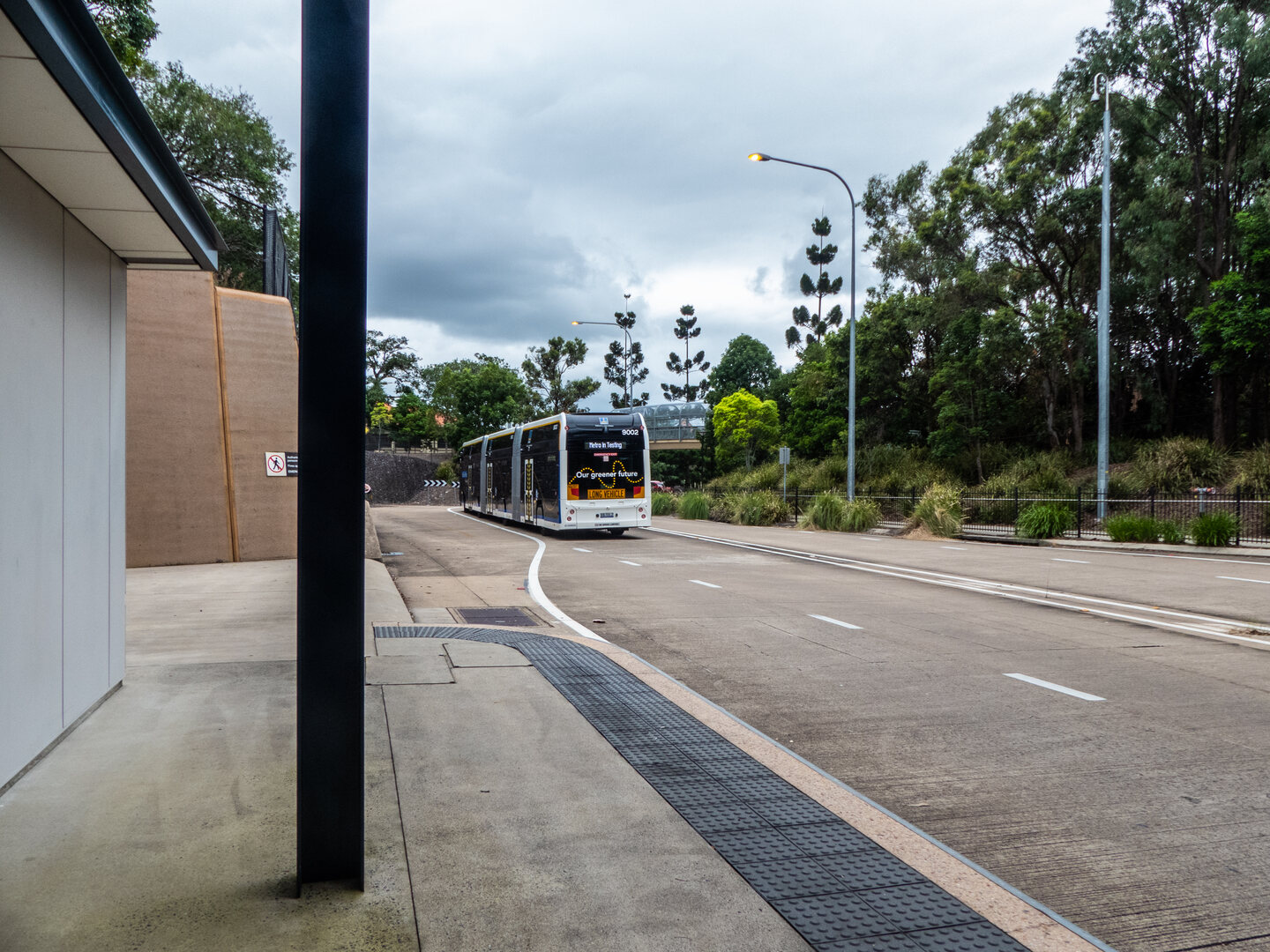
A useful test of Metro East would begin with a stopwatch rather than a vehicle brochure. Start it when a passenger leaves home in Capalaba. Stop it at their destination. Include the walk to the stop, the wait, any change of buses and the final walk. Then repeat the exercise in the evening, on a Saturday and on a day when a connection goes wrong.
That is the journey an eastern extension needs to improve. The minutes spent aboard a new vehicle would be only part of it.
Brisbane City Council is consulting on a proposed Eastern Metro corridor between the CBD and Capalaba. Its expansion business case is expected in late 2027; delivery depends on that work, funding and approvals. The current survey closes at 11.59 pm on 13 December. Those are significant planning milestones, but they are not a construction timetable. Council’s expansion programme
The useful question now is what should be achieved before, alongside and through that larger project. Carindale and Capalaba need a service proposition that can be tested against the journey people already make.
The network already has pieces of the answer
Carindale is not starting without a frequent city connection. Council lists the 222, between Carindale and the city via the Eastern Busway, among its Bus Upgrade Zone services. Its published BUZ standard is at least every ten minutes in peak periods and every fifteen minutes at other times, between 6 am and 11.30 pm. That is an advertised service standard, not evidence that every bus arrives on time. Council’s bus network
Translink’s 222 timetable shows the route linking Carindale interchange with Old Cleveland Road stops through Carina, Camp Hill and Coorparoo, then Langlands Park and the inner busway network. The itinerary illustrates why the entire corridor matters: calling a service a busway express does not mean its whole journey uses a separated busway. Route 222
Further east, route 250 links Redland Bay with Carindale through Cleveland, Alexandra Hills and Capalaba. Its published stops include Capalaba station, the Sleeman Centre and Carindale interchange. It is an example of the existing links that any redesigned network must account for, rather than evidence that every Redlands passenger makes the same transfer. Route 250
An eastern Metro plan therefore needs two sorts of comparison. One is between the present city-bound service and a proposed replacement. The other is between the complete network before and after the change. A faster trunk route can still disappoint someone whose feeder bus becomes less convenient or whose interchange takes longer.
Capacity and reliability solve different problems
The current Metro fleet is designed to carry 150 passengers, or 170 in event mode. Three double doors and low-floor boarding are intended to help people move through the vehicle; charging infrastructure is part of the operating system, not an optional accessory. Council’s fleet specifications
Those features offer a useful starting point for thinking about capacity. They do not establish the correct vehicle, infrastructure or operating pattern for an eastern route. Nor does room for more passengers, by itself, remove a traffic queue.
The business case should show where time is lost and which intervention addresses each loss. If the main problem at a location is a traffic signal or a short queue, a targeted priority treatment deserves assessment. If the problem is persistent congestion over a longer stretch, the case for continuous separation is different. If passengers are being left behind, capacity and frequency need scrutiny together.
These are alternatives to evaluate, not engineering conclusions that can be drawn from a map. A short bus lane can shift a bottleneck to its far end. Signal priority can affect other road users. Taking road space requires a clear account of who gains, who loses and whether more people, rather than simply more vehicles, get through.
There is a local precedent for incremental treatment. In February 2022, Transport and Main Roads described the $30 million Eastern Transitway works around Carindale, including an inbound bus lane and shared-path works. That dated statement documents an earlier investment approach; it does not tell residents how much time the corridor saves today. Publishing measured results from existing priority works would strengthen the next decision. TMR’s February 2022 statement
A transfer is part of the service
Interchanges can look efficient in a network diagram while feeling quite different on the ground. For a parent with a pram, someone using a mobility aid or a worker finishing after dark, the distance between platforms and the quality of the waiting area matter.
A credible plan should therefore describe the transfer itself: the walking route, crossings, shelter, lighting, accessible boarding and information when a service is late. It should also show the timetable consequences. A frequent trunk route is most useful when the connecting service does not impose a much longer wait.
Consider a simple hypothetical. Saving five minutes aboard the main service does little for a passenger who then spends an extra fifteen minutes waiting for a connection. That is not a forecast for Metro East. It is why a claim about faster vehicles needs a corresponding claim about door-to-door travel.
The same test should apply beyond the morning commute. A network serving shops, health appointments, education and weekend work needs an account of off-peak and evening journeys. Otherwise its most impressive results may describe only a narrow slice of the people expected to use it.
What residents should ask for now
Council says the business case will examine alignment, depots, network changes, infrastructure and delivery stages. Residents can use the consultation to demand a clear separation between improvements that require the major project and improvements that could be assessed sooner. Business-case scope
The eventual comparison should include an honest baseline: current journey times and their variability, crowding, transfer waits and the cost of operating the service. It should explain what happens to existing direct routes, rather than leaving that question until people see a replacement timetable.
There is also a funding distinction worth watching. Building an interchange or buying a vehicle is one decision. Paying for enough drivers and service hours to sustain an attractive frequency is another. A capital announcement is incomplete without an operating plan.
For the eastern suburbs, the best outcome would be a sequence of improvements whose benefits can be measured as they arrive. Residents should not have to choose between enthusiasm for a long-term extension and scrutiny of what can be delivered earlier. The measure of success is the same at every stage: a journey that is easier to make, more predictable and worth leaving the car at home for.